

Grand Theft Auto VI overhauls the police into a system that tracks what they know about you, not just where you are. Here's how to get heat — and how to lose it — based on the Extended Look and leak reporting.
How you get a wanted level
The meter runs to six stars again (up from GTA V's five). Small crimes start you low and violence escalates fast:
- Pulling a gun on someone or hijacking a car: around one to two stars.
- Shooting or killing: escalates quickly from there.
Crucially, you usually only get a wanted level if a witness sees the crime and reports it — often by pulling out a phone. No witness, no stars. So dealing with witnesses (or acting unseen) matters as much as running.
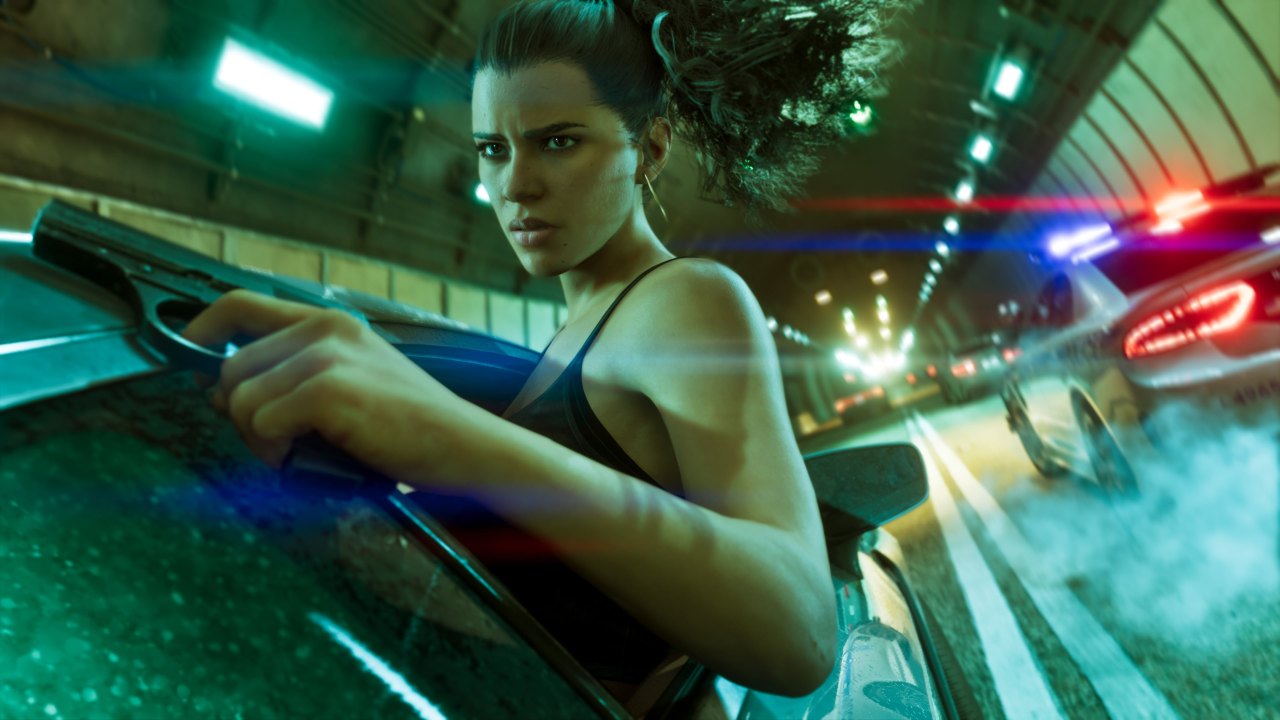
Break the cops' line of sight to shake a chase.
How the police find you
Under the stars sit icons for each way the cops can place you — witnesses, your face, your clothing, your vehicle, CCTV cameras, and whether you're armed. Witnesses give descriptions; cameras capture footage. The full breakdown is in our HUD & wanted system guide.
How to lose the cops
The stars are white while the police can see you and turn red the moment they lose sight — red is your window. To actually escape, cut their leads:
- Break line of sight — get out of view so the stars go red.
- Change your clothes — beat the clothing description.
- Ditch or swap your vehicle — they're hunting the car you were last seen in. Note that changing cars doesn't instantly clear heat — the police keep your description, so you still need to lose their line of sight (torching the old car is shown as an option).
- Put your weapon away — stop broadcasting that you're armed.
- Deal with cameras and witnesses — take cameras out (ideally before a crime) and leave the area witnesses are in.
- Split up — because you play a duo, separating Jason and Lucia drops your wanted level by a star.
Do enough of these while you're out of sight, and the search collapses. It's a Red Dead-style, evade-by-behaviour approach — see the confirmed details on the six-star system and how police track you.
The fine print (from Rockstar's demo)
- Hollow stars = they don't know your face. If the police never got a description, your stars show as outlines — leave the area unseen and you're clear.
- A hat or glasses isn't enough. Changing your hair removes the appearance icon, but they still know your clothes — you need a full outfit change (keep a spare set in your car trunk). Wearing a mask during the crime and removing it after can stop a description reaching the police even via CCTV.
- The crime scene stays "hot." Police keep searching that marked area for a while even after you leave.
- Send your partner to take the heat. You can tell the other character to flee during an encounter; if you split up, you'll get a text once the coast is clear.
- Get caught and it's the classic "Busted" screen — you respawn even if your partner is still running.
- At three-plus stars in the city, tight streets and dense traffic make car chases brutal — ducking into alleys on foot is often smarter.
Confirmed vs unconfirmed
The six-star meter, the identification icons and the white→red visual rule are shown in the Extended Look. Finer mechanics — exact star thresholds and how quickly each lead clears — aren't fully detailed yet. We'll update as Rockstar confirms more.
Verified police and Criminal Profile additions
Jason and Lucia each have a Criminal Profile that tracks how professionally they carry out crime rather than a simple morality score. It can be affected by excessive violence and may reach a shattered state that cannot be reversed. There is no live progress bar, but the information is available in a menu and its notifications can be disabled.
Police do not normally sit on the mini-map in free roam. Below six stars, the map uses different heat/search areas; at six stars, the search can extend across Leonida. The exact wanted interface also tracks information such as CCTV sightings, the protagonists’ identity, clothes and weapons. In story missions, chasing police can still be shown on the mini-map.
Organic pursuit update
Creator-preview reporting describes police pursuits as unscripted in free roam. Shooting out a vehicle’s tyres during a normal chase produces the same kind of dynamic vehicle response seen in the Extended Look highway sequence, rather than switching to a bespoke scripted event.
Rob Nelson reportedly recreated that highway-chase behaviour organically during the preview. This supports the pursuit physics being systemic; it does not establish every police tactic, escalation rule or outcome before release.